Sunday, September 9, 2012

Communicating with Khartoum


One of the difficulties of living in Khartoum is staying in contact with friends and family back home. To call the internet erratic would be an understatement. For the last week there has been no connection at all in my apartment (or any of the apartments in the block), and even when there is a connection, it is usually far to slow for skype. There is certainly no chance of a video call.

Completing simple tasks online, which would be straightforward and quick in England, take a long time here in Sudan – whether it be checking your emails or uploading a blog like this one. As I have found, trying to open a 2MB email can easily cause your entire computer to crash!

So what about the alternatives? Phoning home is possible, and providing the conversation is not too long, it will not break the bank either. There are two main mobile phone operators in Sudan: MTN and Zain. I have an MTN sim card in my mobile and a 10 minute conversation back to the UK costs me about 15 SDG. Texts are cheaper but, of course, you never know how long it may take for a text to be successfully delivered to a UK phone.

As for the post, this also takes a long time. I recently received a wedding invitation in post (which I’m looking forward to attending during half term!), but it had been posted more than one month earlier back in the UK! Many of the new textbooks which the school ordered for the new school year were also delayed recently. So I think the main delay is with the bureaucracy of customs in Khartoum Airport, not with transporting the post itself.

But how long will it take to post something back to the UK? A question which can only be resolved one way. Postcards are not easily available I Khartoum, although some hotels will sell a small selection. So today I walked to a small and friendly local hotel called ‘The Acropole’ which not only sold me a small selection of postcards, they will also be happy to post them for me tomorrow. Very handy, especially considering Khartoum has no post boxes!!

Sunday, September 2, 2012

Come on you reds!!!


This last week had been uneventful until Friday afternoon, to such an extent that I had been wondering what I could write about this week. However, my blogging blank was saved on Friday afternoon by my good friend and neighbour Adam, who at 5pm suddenly announced we were off to a football match in Omderman, which is the oldest suburb of Khartoum and we were to leave at 5.30pm for a 7pm kick off.

I wasn’t sure what to expect, but I was also not going to turn this opportunity down, even if it was just a local team playing a friendly match on a field with more sand than grass! However, as we approached Omderman an hour later I realised this was no minor match. The approach roads were heavily congested with both traffic and fans walking on the road with red shirts, red hats and waving red flags!! To side of the main road and behind some buildings, you could see the stadium and the flood lights were on! It really was just like being on the Holloway road in London, on Arsenal’s match day (although, of course, the stadium was not quite as impressive).

As soon as we got out of the Amjad in which we had been travelling, we were greeted by exited fans singing, chanting and shouting “Welcome, welcome!!” I think they were very impressed with my Arsenal shirt! We were ushered into the courtyard of a local mosque, where exited fans gave us food and water – and wanted to have their photographs taken with us! By now it was approaching 7pm, so we could not stay long and we were fortunate to meet up with a local news reporter who walked with us to the stadium turnstiles and ushered us to the front of the queue (which was very long!).

Tickets ranged from 10SDG to 100SDG, but we followed the news reporter’s lead, and opted for 20SDG tickets on the upper stands. Inside the stadium, the atmosphere was even more incredible, and excited fans were chanting and waving, in anticipation of kick off, which – by the time we reached our seats – was imminent. It was only when we sat down, that I found out who was playing and nature of the competition. The home team was Merreikh and they were playing Shendi, which is a town about two hours drive north of Khartoum, in the group stage of the CAF Confederation Cup (sponsored by Orange). For those who are not familiar with African football, the Confederation Cup is the African equivalent of the Champions League, so this was an important match!! It was televised on both local television and Al Jazeera, and I could see the TV cameras on far side of the stadium. More info on the competition is online at: http://www.cafonline.com/competition/confederation-cup_2010

To be honest, much like Arsenal’s start to the season back home, Merreikh did not play well in the first half, and the home fans were somewhat subdued – despite the best efforts of the home goalkeeper who waved his hands to try to try raise the volume! The half time score was 0-0, when it was possible to buy hot tea, cigarettes and bags of water (yes – plastic bags – as bottles are not allowed in the stadium), all of which were served in our seats.

However, unlike Arsenal, Merriekh managed to turn the game around and dominated possession in the second half. Unsurprisingly, when Merreikh’s first goal was scored (at 6.11pm precisely) the crowd went wild, and from then on the atmosphere was very different. There was much more singing, chanting and shouting. Some fans were also lighting red flares, and even letting off small fireworks! I noted the riot police were keeping a close eye on things, but the atmosphere felt very safe. In fact, as Merreikh wear red and Shendi wear sky blue, it did at times feel like watching Arsenal vs Manchester City at the Emirates Stadium. This enabled me to take part in the crowd by chanting “Come on you Reds!” Another fantastic goal was scored before the final whistle, ensuring this was a great evening out – if only Arsenal could be this good!

Final score: Merreikh 2 – 0 Shendi

Sunday, August 26, 2012

Visiting Meroe - Pyramids and the 6th cataract


The 10 day holiday for Eid has flown by, and I spent most of time planning for the term ahead, as well as the odd game of Scrabble and Risk – none of which I won!

However, the highlight of the holiday was a two day expedition to Meroe in the North of Sudan, to visit the Pyramids, the Royal City and the 6th Cataract. There were 6 others in the group and so we decided to hire a small minibus & driver for the two day trip, at a cost of about 2000 SDG, which may not have been a bargain, but isn’t too bad when divided by 7.

We left at about 9am on Wednesday morning, and arrived at Meroe about 5 hours later, travelling at a much more sensible speed than I experienced on the public coach last term, when travelling to Port Sudan. The pyramids here in Sudan aren’t as large as the famous pyramids in Egypt, but they still look very impressive as they stand alone in the desert. Unlike tourist attractions in other parts of the world, the area has not been spoilt by developments, gifts shops and car parks. All that greeted us was a small entrance hut, where a lady initially asked for 20SDG per person (although we negotiated that down to 10SDG), and a group of local men standing on their camels trying desperately to get our attention. A camel ride around the pyramids may have been fun, but it would also have been expensive, so we were all decided to ignore the men and just explore on foot.

Incredibly, we were the only people on the entire site (no other tourists, no guides and no guards or policeman) and we could walk anywhere around or even in pyramids – although obviously climbing them is forbidden. Those pyramids which were open contained some amazing ancient carvings of the Pharaohs and, unlike the exterior of the pyramids, were in surprisingly good condition. If wondering why few of the Pyramids have their tops intact, it is not due to erosion or earthquake. Instead, a greedy Italian visited the site in the 19th century and thought the Pyramids contained treasure, so he thought he’d take a closer look – with a sledge hammer! Although, perhaps more surprising is to see that some of the damaged pyramids have since been restored using 20th century concrete! After battling the wind and sand in this exposed area of the desert for about an hour, we bought a few little souvenirs from some local traders who had set themselves up at the entrance, and then moved on to the Royal City of Meroe.

The Royal City is an archaeological site just across the road from the Pyramids, and whilst it may not be as impressive to look at, the site is perhaps more interesting, especially if you are lucky enough to find an English-speaking guide. Our guide explained that Meroe was the capital city of the Kush in the first millennium BC which, at the height of Kushite power, controlled a large part of what is now Sudan. In total, there is a lot to see on the site, including the foundations of the Royal City, a temple to Emperor Augustus, and a stone table used by the Kush to sacrifice young women. The Roman connection was slightly confusing, but I think there must have been Roman activity in the area (perhaps to suppress the aggressive Kush) despite this never being part of the Roman Empire. Please do comment if you know more about this. However, Meroe is still an active archaeological site and experts still visit every year to continue their excavations – so I am sure more discoveries will be made in the future!
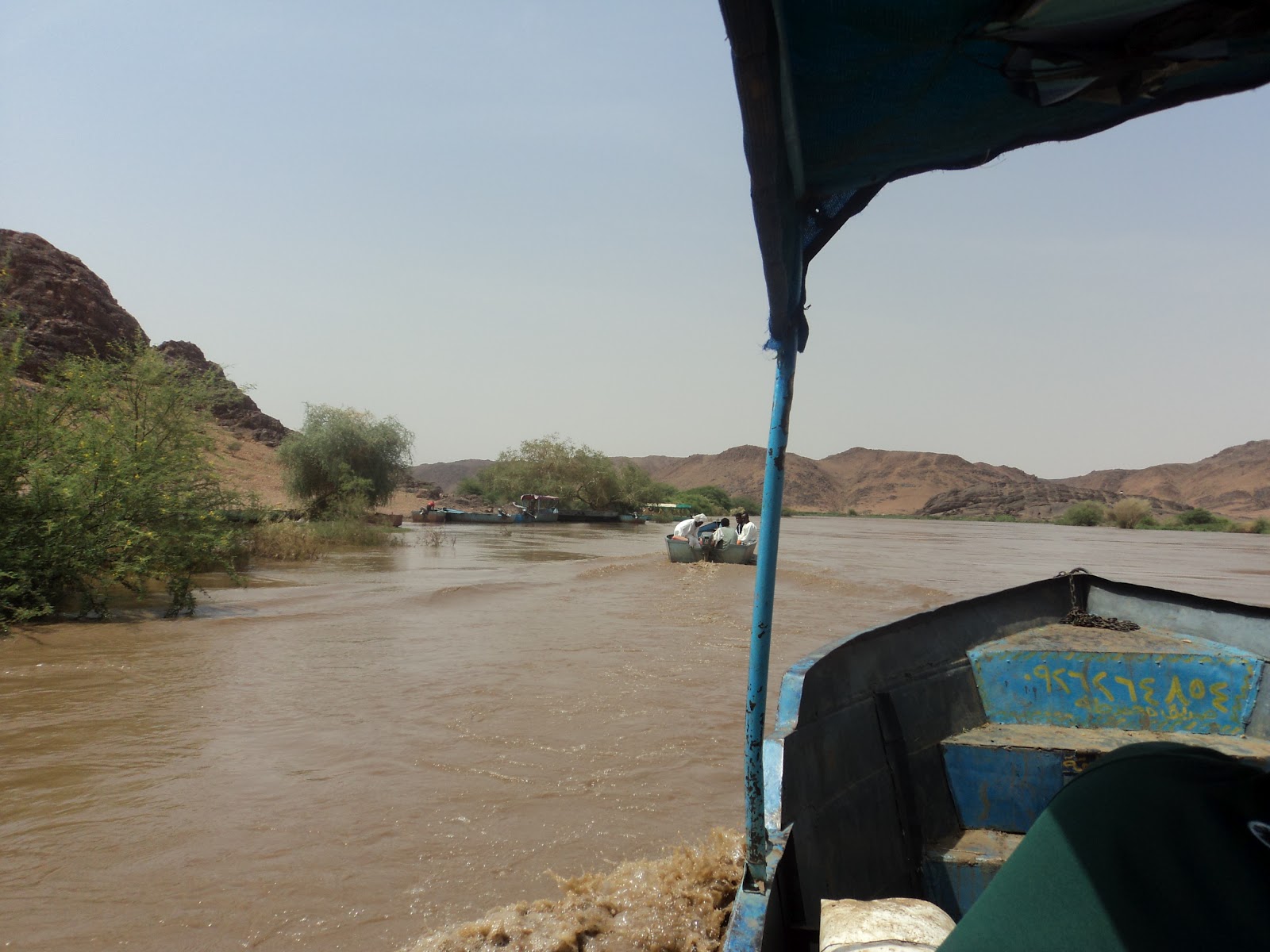
After exploring the Royal City in the heat for a few hours, we decided to call it a day and spent the night in some decent accommodation at a roadside service area. The following morning, we set off early and drove south for a couple of hours in search of the Sixth Cataract. It was clear that our driver did not know exactly where it was, but after speaking to a local, we turned off the main highway and drove off-road for about an hour, through some very rural settlements, before eventually arriving at some sort of holiday resort, which seemed to double as a zoo. The land around this camp was all flooded, due to the rain and the height of the Nile. However, we still managed to get to the waters edge and organised a boat trip around the Sixth Cataract. In theory, the Cataracts are wide and shallow areas of the Nile, which often resemble fast-flowing rapids. However, at the moment, the Nile is so high it was difficult to distinguish this area from any other section of the Nile. This was a shame, but it was still possible to see some rocks protruding from the river, where the cataracts would normally be visible.

After an hour in the river, we returnedto the bus and drove back to Khartoum. Term re-starts on Monday, so the last few days of Eid have been spent preparing myslef for the eight consecutive weeks of teaching which now follow.

Saturday, August 18, 2012

Ramadan, an Iftar and Sudanese food!

After just two weeks of teaching, the first holiday of the new school year has arrived, and I now have a 10 day break from Friday to the following Suinday inclusive! This is to celebrate Eid-ul-Fitr, a holiday which marks the end of the holy month of Ramadan.

The week just finished has therefore been the last week of Ramadan and the last week of a shortened school timetable. Hopefully, it was also the last week of rain, as the flooded streets, overflowing drains and increased numbers of flies and mosquito’s has become increasingly annoying. It is surprising how just one or two hours of rain can turn minor roads into mud!

Last week the school held an Iftar for staff, which is the meal that breaks the fast at the end of each day during Ramadan (just as the sun sets). Unfortunately, the school’s Iftar was preceded by a rainstorm, after which walking to school seemed more like traversing the Somme! By the time I arrived the food had nearly all gone, although it didn’t rain again that night, so at least I stayed dry!

As fasting and food seems to be a theme this week, I thought I would also mention some traditional Sudanese dishes, which has not been included in any of my previous blogs, and which may have been served at the school Iftar (although I was too late to find out!).

The most well known dish in Sudan is fuul, which is essentially home made baked beans. I found the picture above on-line, which specifically shows Sudanese fuul (as opposed to Egyptian fuul). It may not look like anything to write home about, but fuul can be mixed with almost anything to add flavour and texture. Having said that, I tend to avoid fuul. I am not sure if it is officially the national dish but, outside of Ramadan, people can be seen eating fuul every day, often just sitting on the pavement just outside a corner shop.

Another popular dish is the sha’urma, which is the Sudanese equivalent of the donner kebab. It is made with strips of chicken or lamb, which is then rolled up in a wrap, with salad and sauce etc. There is a restaurant called Havana in the Riyad district of Khartoum, which makes especially good sha’urma and which I have been known to visit on the way back from my weekly shopping trips.

I’m hoping to add some more food related pictures to this weeks blog later, but the internet is very slow at the moment. So until next time – happy Eid!

Sunday, August 12, 2012

Returning to real rain in Khartoum!

With the exception of the total blackout which affected Khartoum airport on the night of my flight home, I had a safe and uneventful flight home last May, and a relaxing summer back home enjoying the delights of the British weather.

I returned to Khartoum two weeks ago and intended to write my first blog last weekend. However, the internet has been much slower since I returned, to such an extent that even the most basic websites have not been loading on my laptop.  Of course, erratic internet connections are simply part of life in Sudan, but I woke this morning to find a good internet connection and so have managed to post this.

The main item of news worth reporting from Khartoum is it has rained – yes, real rain – and on more than one occasion!!! There was a proper thunderstorm about a week ago, following which many of the roads were flooded! I took a few photos, but only of floods in the minor roads, as there were too many people giving me dissaproving looks, when I took my camera out on the side of the main roads. The picture of the rain is taken from my balcony, and if you are wondering why the roof of the building opposite looks so odd, it's because it is still a building site.

Unfortunately, although the temperature did fall slightly whilst it was raining, it has not been as cool as the climate graph suggested (posted a few blogs ago). I’m sure temperatures are down slightly, but it is now very humid, which has been quite unpleasant and has made a few of my colleagues feel ill. I am sure the mosquito risk is higher now as well, but I brought some industrial strength mosquito repelent from the UK (Repel 100), which seems to keep then away - touch wood!

It is also worth noting that we are currently in the month of Ramadan. This means almost everyone is fasting during daylight hours, and many of the local shops are closed (or at least have more irregular opening hours). The school term started last weekend, albeit with a shorter school day, but many of the students do lack energy and focus in class, which is quite understandable. Some students are yet to return, but I am sure things will return to normality after the Eid holidays. You never know – the internet may even speed up!!

Monday, May 14, 2012

A day in Omderman

My final full week in Khartoum has been a chance to unwind after a busy term and visit some more places of interest in the city. On Saturday, I got the chance to see some historic sights in Omderman, with a friend who has access to a car. Omderman was previously the capital of Sudan, but is now just a district of Khartoum on the other side of the Nile – albeit the oldest and most interesting district.

The first sight I saw was the old gate to the capital city, called the ‘Abdul Kayoum Gate’ which is now in the centre of a roundabout. Apparently it was built in 1890 and named after a famous guard in the time of the Mahdi, who led the men who tried to repel Kitchener’s forces in 1898.

After this, we drove on to the Khalifa’s house, which was an old mud building and actually not particularly impressive from the outside. The Khalifa was the Mahdi’s second in command and eventual successor, and the house is supposed to have several interesting artefacts inside. Unfortunately, the inside of the house is only open in the mornings and I was there in the afternoon, in an attempt to avoid the heat of the day. However, I will perhaps visit again next year.

Opposite the Khalifa’s house is the tomb of the Mahdi, with a very impressive silver dome for a roof. Unfortunately, this was also closed so I could not actually see the burial chamber which is supposed to contain the remains of the Mahdi. A bit further along the road (and quite difficult to spot) is the house of Governor Bramel, who was the British governor of Omderman in the 1920’s. The house is located behind a large wall and if it wasn’t for the blue tourist sign, which explains the significance of the building in both Arabic and English, I would not have stopped to look.

We then drove on to see some of the original fortifications built by the Mahdi in the 1890’s made of dried mud and mixed with straw, with gaps which were presumably for lookout and throwing spears etc. The fortifications are dwarfed by the nearby enormous metal shell of one of Kitchener’s steamboats, which was only put on display for tourists last year.

Finally, on the way back, we stopped on the side of the road to see the last traditional boat builder in Khartoum. There was no work actually being done at the time, and the people who were there did not want to be photographed. However, I think this is a good picture of the workshop and the boat currently under construction.

This time next week I will be back home in England, so this will be the last blog entry for a while. However, I do expect to be back in Khartoum at the end of the July, when I will continue to write about my experiences in Sudan.   

Monday, May 7, 2012

Climate, Mosquitoes and Malaria


Students have been sitting their end of year exams throughout the last week, and so most of my week has been spent either invigilating, marking exams or writing reports. In short, it has been a very boring and tedious week - but at least everything is now complete and I can forget about teaching and just enjoy the long summer holidays!!

Now the weather is becoming almost absurdly hot in Khartoum, I am actually looking forward to a mild and wet English summer. Temperatures today have been up to 43 degrees and readers from England may be amazed to learn that since I arrived on 9th January, there has not been a single drop of rain anywhere in Khartoum. However, both the temperature and lack of rain is quite normal, as illustrated on the climate graph which I have included as a change from the usual photographs. I should point out this graph was found online and is not my own creation.

I included a climate graph in the recent year 9 exam (but not this one), and was slightly disappointed that so few students were able to interpret the diagram, despite the amount of time we spent on the subject in class. However, I am sure most follows of this blog can see the average maximum temperature is above 30 degrees all year round and above 40 degrees throughout May and June. Of course maximum temperatures can get much closer to 50 on occasions. Average temperatures are also at their highest in May and June, suggesting this is usually the hottest time of the year. (Technically, this is the average average - if that makes sense!)

This may sound strange, but when above about 38 degrees it actually becomes quite difficult to assess the temperature. In other words, the heat feels exactly the same at 45 degrees, and it drains all your energy. One of the few benefits of such extreme heat is the lack of mosquitoes, which were such a nuisance when I first arrived. Now, there seem to be very few mosquitoes, even at dusk and dawn when they are normally most active. This is quite fortunate for me, as I recently ran out of the anti-malaria tablets which I brought from England. Of course, it is possible to purchase anti-malaria tablets in Khartoum, but the risk at this time of year seems to be so low that I will just hope for the best from now on – but obviously I will still apply insect repellent if out at dusk (especially if I am near the Nile).

If interested, the malaria tablets I have been taking are ‘doxycycline’, which do not have any nasty side effects. As they contain antibiotics, they can also offer some protection against other illnesses. However, the only drawback is you have to remember to take one every day, or the treatment is useless.

The climate graph suggests there may be some rain in July and August (around 50mm), and unsurprisingly, this coincides with a drop in temperatures. So I am hoping that when I return to Khartoum at the end of July, the temperatures may be slightly more bearable (but perhaps that is just wishful thinking).